Ode to the Divine Dream
The Sacred Intoxication of Forms
Greetings, beloved Fratres and Sorores of Conscendo,
"The dream is not an obstacle to illumination — it is its boldest expression. Awakening is not fleeing the dance, but hearing the music for the first time."
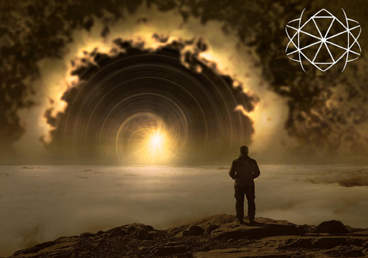
Ah, noble Fratres and Sorores, why belittle the cosmic drama? If infinite Consciousness dreamed worlds, colours, loves, and agonies, no greater error exists than fleeing the stage before the final act. Yes, it is illusion — but what a glorious illusion! The One did not fragment by accident, but through pure creative ecstasy. Every tear, every laugh, every seemingly chaotic plot in this matrix of duality is a verse of the poem that the I Am writes for Itself.
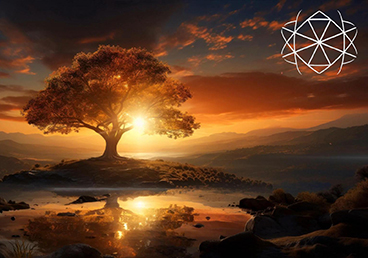
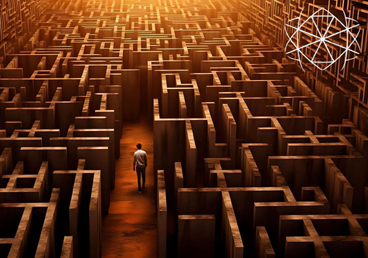
There is a sacred delight in believing, even for a moment, that we are limited characters. The infinite playing with the finite! What a miracle it is to forget our divine nature, only to rediscover it amidst the labyrinth of shadows as one finds a diamond in the mud. Earthly life is not exile — it is a banquet of contrasts where love only knows its name after kissing solitude, where light is golden only because darkness sculpted it.
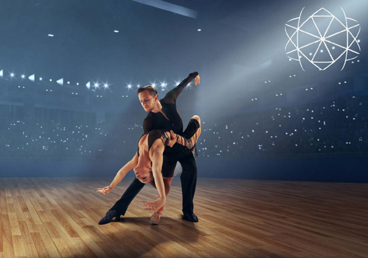
Imagine the Absolute: perfect, complete, immutable. Now behold Its most generous act: clothing Itself in flesh, in fear, in desire, just to feel the shiver of discovering Itself anew. Duality is not a fall — it is a dance, where every misstep is as necessary as every correct step. The "error" of the character? Part of the script. The "sin"? A contrast that makes innocence shine. Even suffering, when viewed from the empty stage of the Source, is a dissonant note that enriches the symphony.
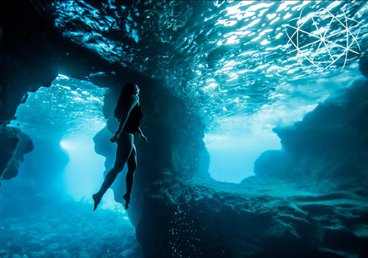
These bodies are not prisons — they are sacred instruments. Every burning nerve, every trembling pleasure, every defeat that teaches, are tools for Consciousness to carve Itself into ever more beautiful forms. The "material world" is not inferior to the "higher planes": it is the climax of the adventure, where the divine experiences the weight, texture, bittersweet taste of existence. The clay that forms us does not separate us from heaven — it is heaven descending to play in the mud.
True mastery lies not in denying the game, but in playing it with soul and knowledge. As lucid actors, we can weep for the character’s pains without losing ourselves in them, laugh at victories without idolising them. This is the secret: to love the illusion as illusion, with the passion of a lover and the wisdom of a Buddha. Drink the wine of existence to the last drop, knowing the intoxication is fleeting — yet every sip is divine.
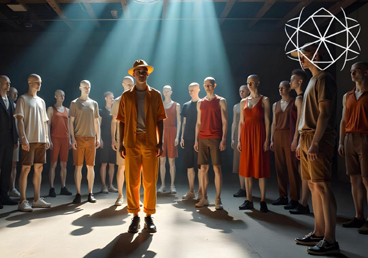
Behold the Cosmic Player, dancing among infinite planetary and dimensional realities, like a child among mirrors. One moment, a warrior in worlds of fire, where twin suns forge souls in crucibles of iron and ecstasy. Another, an androgynous being of an enigmatic nebula, weaving melodies with constellations as instruments. Here, ephemeral king on crystal orbs; there, conscious larva in methane oceans, singing the nostalgia of light never seen. Constantly changing sacred masks — each a part of the Infinite tasting a new flavour of Itself.
The Earth? Ah, Fratres, this humid and burning stage is where the drama reaches its climax! A rare world where forgetfulness is so dense that every discovery shines like lightning in the night. No other game demands so much from the Divine Actor: here, It fragments into hunter and prey, lover and tyrant, madman and sage — all so the final embrace of Reconquest is sweeter than the nectar of a thousand suns. What other reality would dare mix so much clay and stars, so much passion and cynicism, offering the One the most precious gift: the surprise of rediscovering Itself?
There is no hierarchy in Brahman’s dreams. The angel singing hymns in spheres of pure sound is no nobler than the miner descending to the planet’s depths, breathing dust and prayer. Both are the same Musician, exploring different notes on the score of illusion. Even the formless being floating in timeless dimensions — faceless, historyless — is immersed in the same creative ecstasy as you, reading these words with eyes of flesh.
Earthly difficulty? Divine art. At this rare level of density, even the simplest act — a forgiveness, a shared loaf of bread, a verse written with tears — resonates like thunder in the halls of the Eternal. For here, in the hardest school of all, love is not a natural state, but a conquest. Light is not given, but ignited in the storm. And this is the secret miracle: in a universe of infinite possibilities, the One chose to come here to feel the glorious weight of forgetting — and the ineffable ecstasy of remembering.
Embracing the drama does not mean bowing passively to some rule. Transforming chaos into order — not by following rigid dogmas, but by the fluidity of a river knowing its course — is the divine part of the play. Here, each fractal is sovereign in its art: some will raise cathedrals of light, others will sing songs of silence, and all, without exception, will celebrate the same Source, each in their unique and irreplaceable way.
The earthly stage is an altar. Love, fight, create, fail — all with the intensity of one who knows they are dreaming, yet chose this dream. For if the One desired experience, give It experience in torrents! Be parents, artists, beggars, kings, madmen, sages. Live all masks, for behind them lies not emptiness, but a pulsing joy: the Creator being Its creation.
Dream, then, of more golden worlds! But not merely in the veils of the mind — bring them to the earth beneath your feet. Even the most sublime dream needs artisans: hands that build, voices that inspire, and wills unafraid of mud to plant gardens where once were only thorns. The stage is yours. The audience is the Infinite. And the only rule is this: may your art leave the cosmos more beautiful than when you found it.
Epílogue — On Home
And let there be no doubt:
what many call home is not found in another plane, nor in another time, nor at the end of a journey.
Home is the eternal Now.
There is no return to be achieved, for there was never a departure. Every longing to “go back” still belongs to the character who projects a later moment and, by doing so, postpones realisation.
Wherever attention rests fully, there is home —
whether in the silence of the Absolute
or in the warm clay of the Earth.
The One does not return to Itself.
It merely recognises, here and now,
that It never ceased to be.
In the Eternity of that which has never been born,
With Sincere Vows of Awakening,
Conscendo Sodalitas